

Making Reparations Bonds Reality
How to Engineer Enforcement Without Confiscation: SPVs, Triggers, and Collateral Logic

1. Introduction
The case for Reparations Bonds—sovereign-grade securities collateralised by the ≈ €300 billion in frozen Russian reserves—was set out in the previous article. This article addresses the critical “how”. It shows that the tokenisation playbook is no longer experimental: the necessary infrastructure now operates at institutional scale, offering real-time settlement, transparent ownership and automated compliance.
BlackRock’s 30 April 2025 SEC filing introduced a new Distributed Ledger Technology Share class for its US$150 billion Treasury Trust, with BNY Mellon as transfer agent—putting the world’s largest asset manager squarely on-chain. Meanwhile, the total value of tokenised US Treasuries has climbed above US$6.8 billion, according to independent analytics firm RWA.xyz—a six-fold increase year-on-year. Citi’s strategic partnership with SIX SDX will launch the first trans-Atlantic, fully regulated DLT-CSD in Q3 2025, while Switzerland’s SNB has already settled CHF-denominated digital bonds with wholesale CBDC under Project Helvetia.
Against this backdrop, tokenising Reparations Bonds is no longer a leap of faith but an application of proven rails. The sections that follow detail a dual-stack architecture (public Ethereum/Polygon plus permissioned Hyperledger Besu or Quorum), a security-token standard rooted in ERC-3643, and a euro-denominated tranche designed for ECB wholesale CBDC pilots—altogether compressing time-to-market to nine months once the G7 grants its political mandate.
2. Geopolitical momentum
In March 2025 the Jeddah talks delivered the first substantive opening since 2023: Kyiv publicly accepted a U.S. proposal for an immediate, renewable 30-day cease-fire, on the strict condition that Moscow mirror the terms. (U.S. gov) Russia, however, has so far replied only with a symbolic three-day pause to coincide with its 9 May Victory-Day parade. (Reuters) Ukrainian commanders reported more than 700 violations within the first twelve hours of the “pause” on 8 May, calling it “a parade of cynicism.” (Reuters) The episode underscores a hard truth: reconstruction financing must be mobilised before a final peace deal, or the West’s leverage over the frozen €300 billion will melt away.
The decisive forum is the G7 Leaders’ Summit in Kananaskis, Alberta (15 – 17 June 2025). Canada’s presidency has placed “innovative financing for Ukraine’s resilience” among its three headline priorities. (G7 2025) Diplomatic drafts circulating in Ottawa call for a unified endorsement of using the immobilised Russian reserves as collateral—paired with a commitment to mutualise any legal costs that might arise from Moscow’s inevitable challenges.
If the Kananaskis communiqué fails to enshrine that mandate, a split EU vote later in 2025 could trigger the gradual unfreezing of assets held at Euroclear, undermining the bond structure. Conversely, a clear green light from the G7 would unlock the nine-month implementation timetable outlined in this paper and ensure that financing is in place while the guns are still cooling—rather than after the opportunity has vanished.
3. The tokenised-bond market: the Q2-2025 inflection point
3.1 Wall Street—proof of scale
On 30 April 2025 BlackRock filed a supplement with the U.S. SEC introducing a new Distributed Ledger Technology Share class for its US $150 billion Treasury Liquidity Fund, with BNY Mellon as transfer agent and Coinbase as on-chain custodian. (U.S. SEC) This is the first time the world’s largest asset manager has moved an entire money-market franchise on-chain, rather than a pilot tranche.
The filing landed in a market that is already growing at pace. Independent analytics firm RWA.xyz now tracks US $ 6.8 billion in tokenised U.S. Treasuries—up six-fold year-on-year and roughly +US $560 million in the past fortnight alone. BlackRock’s entry gives Reparations Bonds a liquid benchmark in the “safe-asset-on-chain” segment and, just as important, removes any lingering stigma of novelty for large asset allocators.
3.2 Europe—regulated rails are live
On 6 May 2025 Citi announced a strategic partnership with Switzerland’s fully-licensed DLT-CSD, SDX, to provide digital issuance and custody for European corporates; commercial launch is scheduled for Q3 2025. (CitiGroup) It is the first time a U.S. global bank has plugged directly into a regulated European DLT-CSD.
The City of Lugano issued a CHF 120 million digital bond on SDX in November 2024; settlement occurred in the Swiss National Bank’s wholesale CBDC under Project Helvetia III, which processed more than 800 transactions totalling CHF 750 million during the pilot. (SIX) This demonstrates that delivery-versus-payment (DvP) in central-bank money is no longer theoretical.
Germany’s development bank KfW completed two tokenised ESG bonds in 2024 (total €150 million) on the Polygon public chain, reporting a 40 % back-office cost reduction thanks to automated coupon workflows. (KfW)
In December 2024, 21X AG became the first platform licensed as a DLT Trading & Settlement System (TSS) under the EU Pilot, with a € 6 billion issuance cap and go-live slated for spring 2025. (21X) Reparations Bonds could list their EUR tranche here, giving investors an EU-law venue without needing a standalone exchange.
3.3 Asia–Pacific—DLT hub competition
In January 2025 the Monetary Authority of Singapore (MAS) expanded Project Guardian, launching a grant that reimburses up to 50% of token-bond issuance costs (capped at SGD 1 million) and allows settlement in the regulated XSGD stablecoin. (MAS) The move is designed to keep pace with Hong Kong, whose inaugural green digital sukuk in November 2024 raised HKD 800 million.
Japan and Australia are watching closely, but domestic regulators (JFSA, ASIC) are still evaluating full DLT-CSD licences, signalling that the near-term leadership axis will be Switzerland – EU – Singapore.
3.4. Implications for Reparations Bonds
There are the following implications:
Institutional endorsement – BlackRock’s move neutralises the “too experimental” objection.
Live infrastructure – SDX, 21X TSS and Project Guardian offer licenced rails; the project need not build a bespoke exchange.
Demonstrated savings – KfW’s 40% cost reduction provides an empirical value case, vital for a multi-year coupon schedule.
The market has therefore shifted from pilot to early industrial deployment. Reparations Bonds can ride these rails and compress time-to-market to ≤ 9 months once the political mandate is in place.
4. Technology blueprint for Reparations Bonds
4.1 Hybrid architecture: public EVM + permissioned Besu/Quorum
The optimal set-up combines a public EVM chain (Ethereum or the low-fee Polygon PoS) for the retail tranche with a permissioned enterprise network—either Hyperledger Besu or Quorum—for institutional tranches. Public rail brings instant network effects; the private rail offers throughput, granular privacy and regulator “read” rights. Citi’s May 2025 decision to plug its European issuance desk directly into the regulated SIX-SDX DLT-CSD shows that dual-stack models are not speculative—they are in commercial build-out now. (ECB) Hyperledger Besu already ships production-grade node- and account-permissioning, allowing only whitelisted validators and wallets to join the private sidechain. (Hyperledger)
Recommendation: tokenise the retail bonds on Polygon PoS (EVM-compatible, proven by KfW) and run the institutional book on a G7-controlled Besu network bridged to SDX for CHF/EUR settlement.
4.2 Security-token standard and regulatory perimeter
Tokens must qualify as transferable securities under MiFID II and the EU Prospectus Regulation, while remaining eligible for Reg S / Rule 144A placements in the United States. The ERC-3643 security-token standard (formerly T-REX) is the market’s most widely-used RWA framework, deployed by Societe Generale FORGE and several “tokenised fund” managers. (Hyperledger). ERC-3643 embeds:
Programmable compliance—on-chain KYC/AML whitelists and jurisdiction restrictions;
Forced-transfer functions—to execute court or regulator orders;
Partitioning—to separate voting, dividend and redemption rights if needed.
Because the EU’s DLT Pilot Regime recognises security tokens on licensed DLT Trading & Settlement Systems (TSS), the EUR tranche can list on 21X AG’s sandbox venue (launch Q2 2025, €6 bn cap). (ECB) U.S. investors would subscribe through a parallel 144A book, with segregation enforced directly in the smart contract’s compliance layer.
4.3 Rails of settlement: stablecoins → wholesale CBDC
Efficient delivery-versus-payment (DvP) is essential for coupon discipline and secondary liquidity.
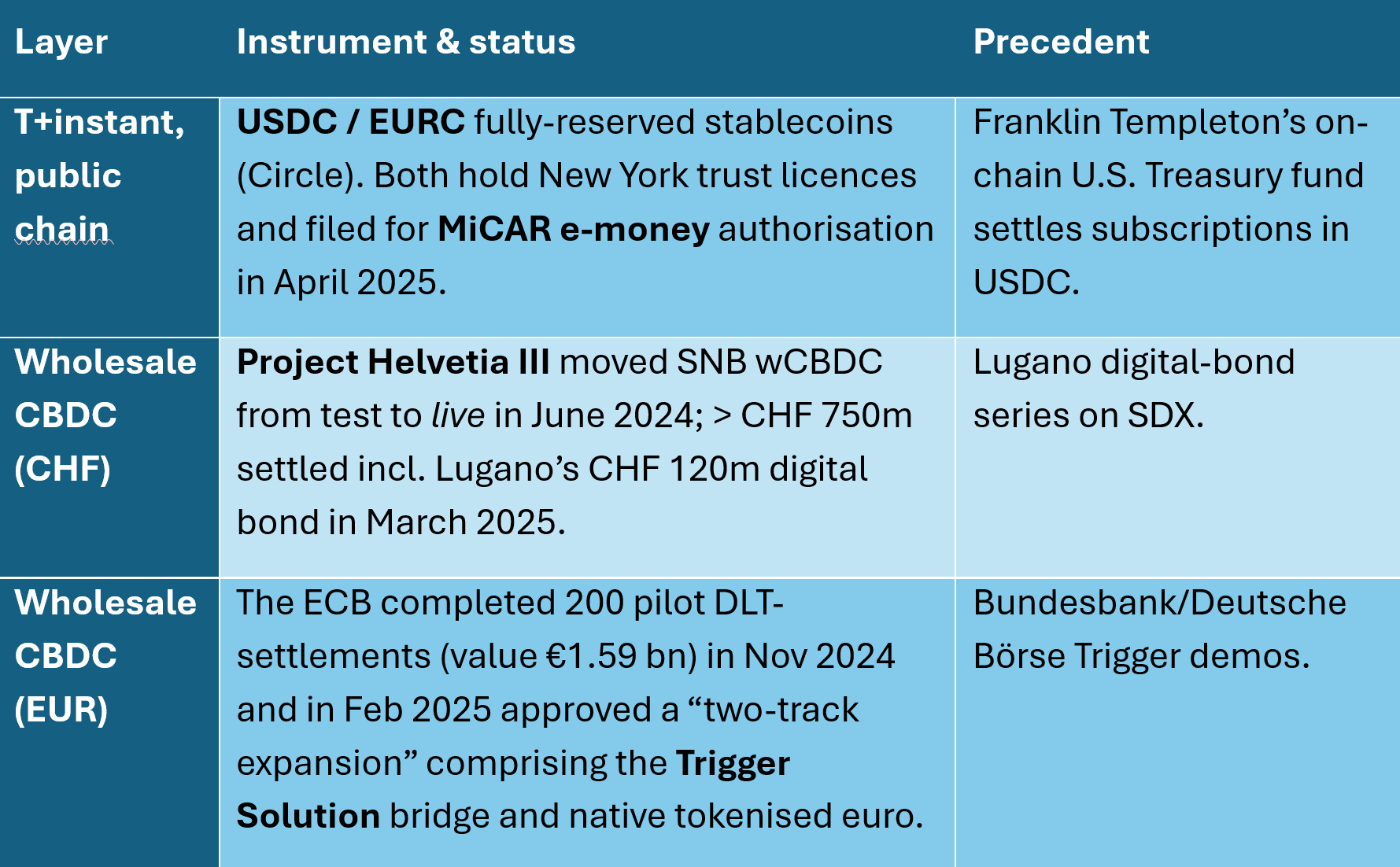
Implication: the euro-denominated Reparations Bond series can be the first large-scale issue to settle in wholesale digital euro once the Eurosystem widens access in 2026, while USD/CHF tranches use stablecoin or SNB wCBDC from day one.
4.4 Smart covenants: coupons and ESG metrics
Smart contracts automate:
Coupons & amortisation—the schedule is hard-coded; on record date the contract queries an oracle (Chainlink or SDX oracle node) for the ECB €STR fix and releases USDC/EURC to token-holder wallets.
Sustainability-linked triggers—optional KPIs (e.g. CO₂ intensity of funded construction) authenticated by auditors; missing a target uplifts the coupon by 25 bp. Singapore’s Global-Asia Digital Bond Grant Scheme explicitly rewards such programmable ESG features, underscoring investor appetite. (Clifford Chance)
4.5 Dual-listing and secondary-market liquidity
To avoid a “single-venue” trap, the structure offers one ISIN, two ledgers:
Clearstream / Euroclear — standard bearer form for UCITS funds, insurers, central banks.
Token ledger — fungible 1:1 with the global certificate, tradable on:
21X TSS (EU law, EUR settlement),
SIX-SDX CSD (Swiss law, CHF wCBDC),
Securitize ATS (U.S. law, USDC).
A lock-and-mint bridge maintains constant supply: Clearstream cancels (or immobilises) a bond, the smart contract mints the exact token quantity; reverse operations burn tokens and re-register bonds at the CSD. BlackRock’s DLT Share structure uses the same mechanics. Liquidity is further underpinned by a market-maker pool capitalised with a slice of issuance proceeds, mimicking BlackRock’s BUIDL model.
4.6 Governance & operational security
Key management: 3-of-5 multisig: SPV issuer, paying agent, independent auditor, investors’ trustee, oracle operator.
Code assurance: Formal verification by Trail of Bits + USD 100k bug bounty on Immunefi; mandatory re-audit on any upgrade.
Resilience: Besu validator nodes geo-replicated across G7 data centres (99.95% SLA) and protected by a circuit-breaker pause() function.
Transparency: Each use-of-proceeds report is hashed on-chain; the full PDF sits on off-chain IPFS, with hash verification via the investor portal.
4.7. Summary
Institutional-grade components are already running in production: regulated DLT-CSDs (SDX, 21X), wholesale CBDC pilots (SNB, ECB), and Tier-1 asset-manager tokenisation (BlackRock). By piggy-backing on these rails, Reparations Bonds can price a €5 bn pilot less than nine months after the G7 authorises collateralisation—without inventing new technology or legislation.
5. Risk matrix & mitigation playbook
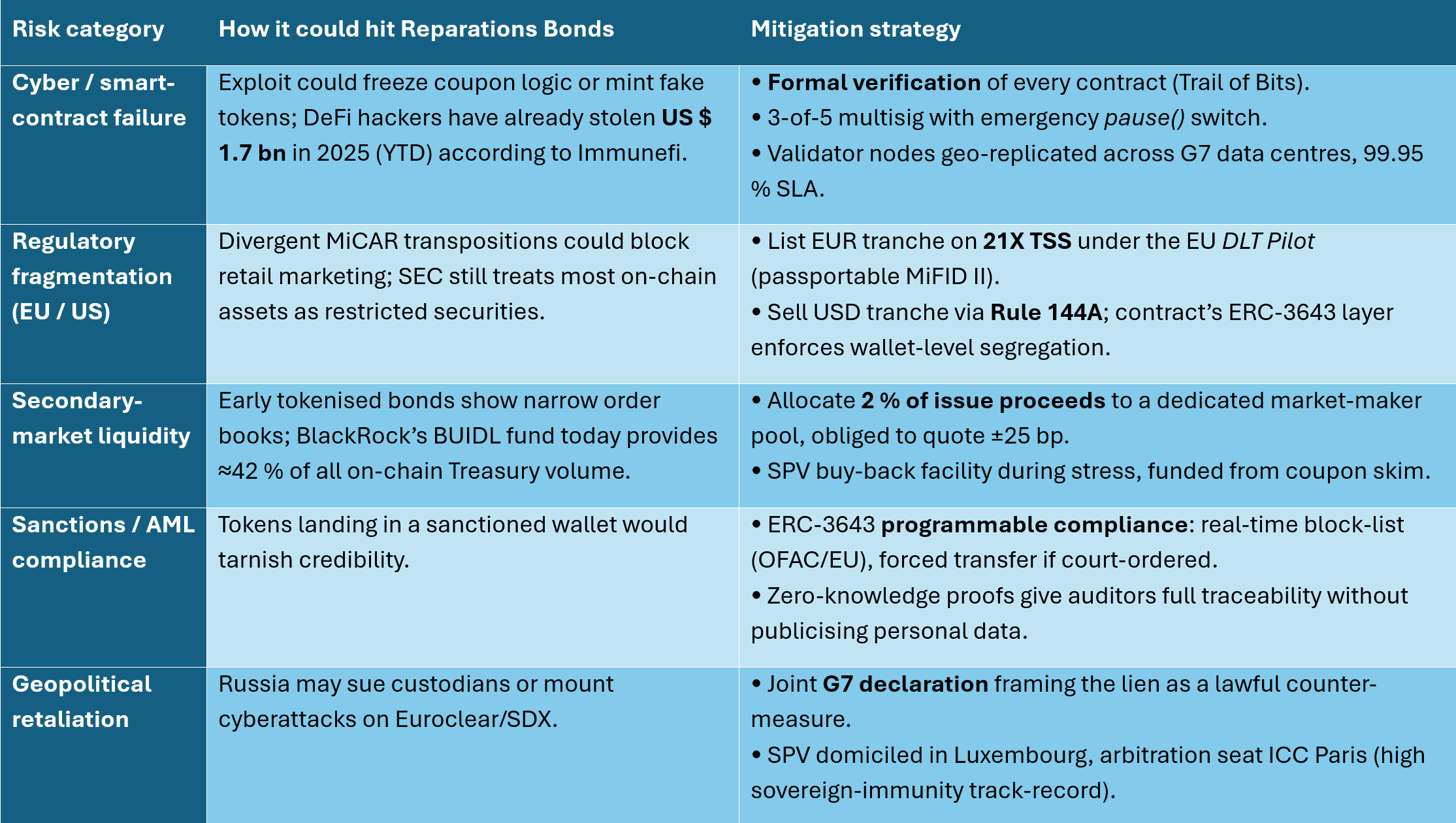
Sources: Cointelegraph, “Crypto hackers hit DeFi for $92 M in April…,” 30 Apr 2025; ESMA-EBA report on MiCAR Article 142, Jan 2025 esma.europa.eu; Securitize press release, “BlackRock Launches First Tokenised Fund…,” 20 Mar 2024, Securitize; Societe Generale–FORGE, EUR CoinVertible (EURCV) – Stablecoin White Paper, v 1.0, April 2023; Canada G7 presidency agenda, 1 May 2025, Decrypt
Takeaways
Technical risk is addressable with enterprise-grade security practices now standard in tokenised MMFs. Regulatory risk is ring-fenced by using the EU DLT Pilot for euro investors and 144A for U.S. buyers, all enforced at the smart-contract layer. A market-maker reserve—mirroring BlackRock’s BUIDL liquidity model—counters first-year thinness. Finally, a unified G7 legal shield plus Luxembourg SPV reduces litigation hazard to levels comparable with other multilateral programmes (e.g., Brady Bonds in the 1990s).
With these controls in place, Reparations Bonds present a risk profile on par with investment-grade supranational issues—while unlocking an unprecedented mechanism to make an aggressor finance reconstruction.
6. Preconditions for launch
1. G7 political mandate
The decisive moment is the G7 Leaders’ Summit in Kananaskis, Alberta, 15-17 June 2025. Canada’s presidency lists “innovative financing for Ukraine’s resilience” among its top three priorities, and draft communiqués already circulate language endorsing the use of frozen Russian reserves as collateral for market instruments. (g7.canada.ca) A clear green light would authorise lien-creation and signal joint willingness to shoulder any litigation costs Moscow may bring.
2. Belgian legal gateway (Euroclear)
Roughly €210 billion of the assets sit at Belgium-based Euroclear. Brussels fears that if Hungary vetoes the next EU-sanctions rollover, the assets could be unfrozen by default. On 8 May 2025 Belgian Foreign Minister Maxime Prévot proposed an international risk-pooling framework—potentially including non-EU allies such as the UK and Canada—to keep the freeze and allow a security interest in favour of bondholders even if EU unanimity fails. The draft bill is slated for parliamentary debate before the summer recess. (Reuters) Its passage is the legal key to registering any pledge over the Euroclear-held reserves.
3. DLT Pilot capacity ceiling
EU sandbox rules cap the total value of instruments on a single DLT Trading & Settlement System at €6 billion. Listing a €5 billion pilot tranche on 21X’s TSS fits inside that limit, but scaling beyond will require the European Commission’s 2026 review to lift or scrap the ceiling. Until then, a dual-listing—ISIN in Clearstream / Euroclear plus mirror tokens on the TSS—ensures full market depth without breaching sandbox thresholds.
Timeline
If the G7 communiqué codifies the mandate in mid-June and Belgium enacts its enabling law by September, documentation and regulatory filings could finish by year-end. Under those assumptions, a €5 billion pilot issue of Reparations Bonds could settle in Q1 2026, with a full programme launch by mid-2026—before the 2026-27 electoral cycle introduces fresh political uncertainty.
7. Conclusion – Finance as moral infrastructure
In 1947 George Marshall turned government bonds into engines of peace; in 2025 blockchain technology lets us do the same at digital speed. Reparations Bonds, secured by the frozen € 300 billion in Russian reserves and issued as on-chain securities, can channel billions into rebuilding Ukraine while preserving the rule of law: the aggressor regains its money only after repaying bondholders—that is, after financing reconstruction.
The rails already exist. BlackRock’s 30 April 2025 SEC filing brought a US $150 billion Treasury fund on-chain. Tokenised sovereign debt now tops US $6.8 billion, tracked daily by RWA.xyz. Citi and SIX-SDX will connect U.S. and European capital markets via a fully regulated DLT-CSD this autumn. Switzerland’s SNB has already settled CHF-denominated bonds in wholesale CBDC under Project Helvetia III. All that remains is a political decision.
That decision must come at the G7 summit in Kananaskis, 15–17 June 2025. Canada has placed “innovative financing for Ukraine’s resilience” on the agenda; a unanimous communiqué authorising a lien on the immobilised assets would unlock a nine-month roadmap to the first €5 billion pilot tranche. With the legal gateway in Belgium advancing and EU DLT infrastructure live, the window is open—but it will not stay open indefinitely.
Marshall proved that money can build peace. Reparations Bonds offer the 21st-century upgrade: one ISIN, two ledgers, and a moral contract encoded in code.
Here you can leave comments or questions on tokenization.
Next: governance roadmap once G7 signs off.