

Reparations Without Confiscation
A Third Path: Financing Reconstruction Without Crossing the Confiscation Line

Author: Prof. Krzysztof Piech, Institute of International Economic and Political Relations, Lazarski University (Warsaw, PL)
Western countries have frozen over $300 billion in Russian state assets — but haven't used them. This article outlines a bold yet lawful way to unlock those funds without confiscation. By issuing reparations bonds backed by frozen reserves, we can finance Ukraine’s recovery and restore accountability to international law.
A Vision for Justice in a Time of Crisis
Picture a mother fleeing Ukraine’s war-torn east in 2022, her child in tow, as Russia’s invasion unleashes chaos—and the West responds by freezing $300 billion in Moscow’s sovereign assets.
Today, in April 2025, that fortune still sits idle. It could rebuild a nation. Instead, it remains locked in legal hesitation.
This article proposes a lawful and urgent path forward: Reparations Bonds, issued by a G7 or European institution, backed by those frozen assets—not confiscated, but held as collateral. Russia retains ownership, reclaiming its wealth only by paying reparations. Peace becomes its path to recovery.
Grounded in international law, endorsed by legal scholars like Harvard’s Laurence Tribe, and powered by blockchain innovation, this isn’t theory—it’s implementation-ready.
With July 2025 looming as a deadline to act before diplomatic leverage fades—and as Poland’s EU presidency concludes—the window for impact is closing.
From a refugee’s footsteps to a rebuilt Kyiv, this is how we transform frozen funds into a framework for justice. Delay is no longer an option.
1. A Strategic Opportunity Hidden in Legal Ambiguity
On a frigid morning in late February 2022, as snow blanketed the Polish border town of Przemyśl, a Ukrainian mother trudged across the frontier, her young daughter clinging to her hand—their lives shattered by the distant thunder of Russian artillery pounding the outskirts of Kyiv. That same week, as the world recoiled from Moscow’s full-scale invasion, the West struck back—not with bombs, but with a financial counteroffensive: a massive freeze that locked away over $300 billion of Russia’s sovereign assets. It was a thunderclap of resolve, a clear message that aggression would carry a price.
Yet now, in April 2025, those billions remain untouched—a colossal lever for justice, gathering dust in the vaults of Euroclear, the Bundesbank, and other G7 institutions, caught in a web of unresolved legal tension.
This paralysis stems not from indifference, nor from lack of means. The assets are there—vast, liquid, and waiting. The moral case is unequivocal: Russia’s war has been condemned by UN General Assembly Resolution ES-11/1 (2022), and the devastation it caused is undeniable. What’s missing is a lawful, actionable mechanism—something that honors the complex architecture of international law, sidesteps the political and legal landmines of outright confiscation, and channels real relief to a nation on its knees.
That mechanism exists. I call it Reparations Bonds.
Imagine a financial instrument—issued by a G7-backed trust or a European special vehicle—that uses Russia’s frozen reserves as collateral. Not confiscated. Not liquidated. Collateralized. The funds would raise $300 billion or more to rebuild Ukraine’s cities, hospitals, schools, and livelihoods. Russia would retain legal ownership of the assets—but could only reclaim them by first paying reparations and engaging in a peace process, thus tying its economic recovery to the restoration of international norms.
This is no radical departure from legal precedent. It is a creative leap within the rules. A lawful detour around political deadlock. A bridge between the frozen present and a reconstructed future.
First proposed in my Substack reflections of March 2025, this idea has steadily gained momentum as the July 2025 deadline approaches, as stated in the article published recently at Politico—a moment when these assets could slip back into Russian hands unless the West acts decisively. With Poland’s EU Council presidency ending that same month, the window for action is closing fast.
From that mother’s weary footsteps across the Polish border to the rubble-strewn streets of Mariupol, the stakes are as human as they are historic. We hold a $300 billion key to justice—not a weapon to wield, but a tool to rebuild. The question is not whether we can use it. It is whether we will dare.
This article charts that path—why it's lawful, why it's urgent, and how it could reshape the world’s response to war itself.
2. From Frozen Fortune to Strategic Leverage: The Power of $355 Billion
What if the West held a fortune so vast it could rival the war chest of an aggressor state—yet chose to let it lie dormant while a nation bled? That’s the grim reality of Russia’s frozen sovereign assets in 2025. Totalling $355 billion, they represent the largest freeze of state assets since World War II— dwarfing Iraq’s $40B in 1991, Iran in 1979, and even Libya in 2011. This isn’t just a sanction. It’s strategic capital with the power to rebuild a nation—or, if left unused, to embolden its destroyer.
These assets come in two streams:
$300 billion in central bank reserves, with $210 billion locked at Euroclear in Belgium, and the remainder scattered across the Bundesbank, Bank of England, and Bank of Canada.
$55 billion in oligarch assets, including yachts, London mansions, Swiss accounts, and art locked in Geneva’s freeports (European Commission, 2024).
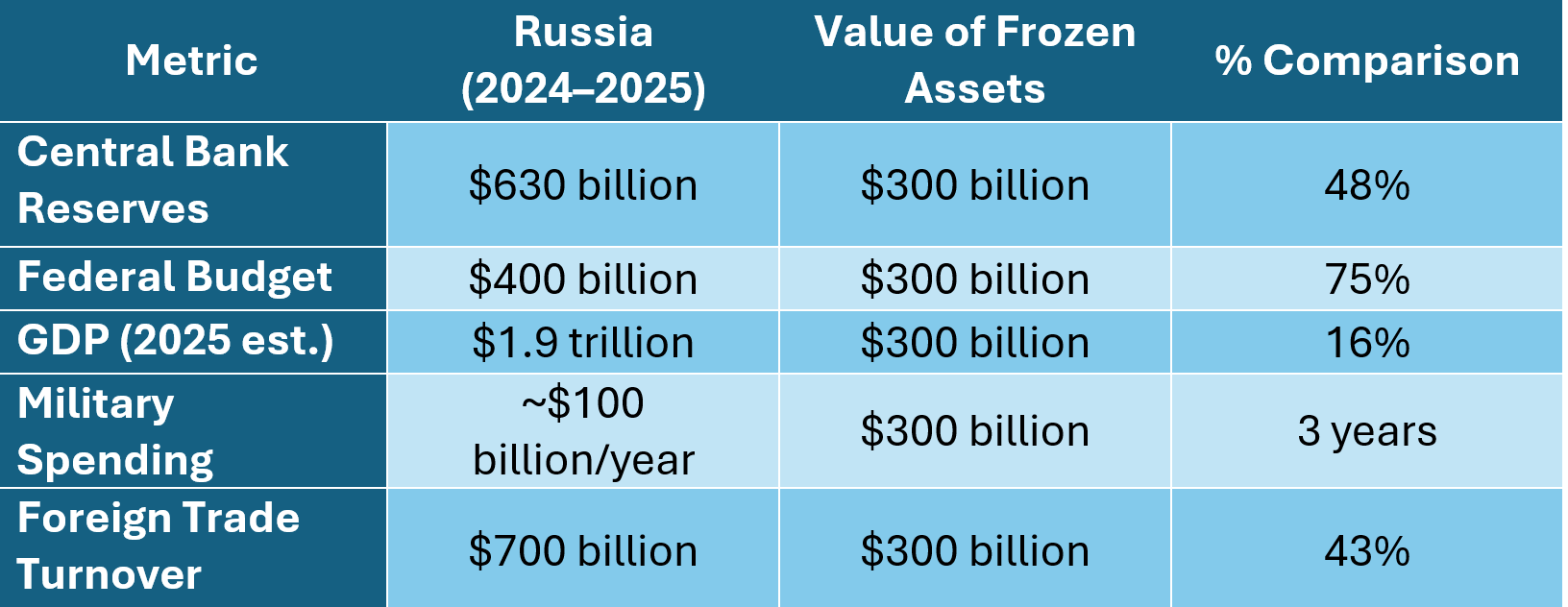
The scale isn’t just impressive—it’s decisive. Before the war, Russia’s reserves stood at $630 billion, meaning the West froze nearly half: 48% (IMF, 2021).
That’s 75% of Russia’s 2024 federal budget of $400 billion (Russian Ministry of Finance, 2024).
It equals 16% of the country’s 2025 GDP, forecast at $1.9 trillion (IMF, 2025).
It could fund three years of Russia’s military spending (~$100B/year per SIPRI).
It matches 43% of Russia’s total foreign trade turnover (World Bank, 2024).
Table 1. Macroeconomic Scale of Frozen Russian State Assets
Source: IMF, ‘Russia Economic Outlook,’ 2021; Russian Ministry of Finance, 2024; IMF, ‘World Economic Outlook,’ April 2025; SIPRI, 2024; World Bank, 2024.
This isn’t a technicality. It’s a Marshall-scale lever for modern recovery.
After WWII, the U.S. invested $13 billion—roughly $150 billion today—to rebuild Europe. That was the Marshall Plan. Today, we hold more than double that amount, frozen and unused. If deployed through Reparations Bonds, it could fund half of Ukraine’s estimated $486 billion reconstruction cost.
A missed Marshall Moment? Perhaps. But it doesn’t have to be. This isn’t about punishing Russia. It’s about enabling Ukraine’s survival—and doing so legally, proportionally, and with purpose.
To leave these billions idle is to squander a once-in-a-century opportunity—one that could ripple far beyond Kharkov and Kyiv. It would signal to would-be aggressors that international law doesn’t just speak—it acts. And it would show the Ukrainian mother who fled in 2022 that her sacrifice mattered, not just in memory, but in bricks, books, and bridges.
3. Turning Law Into Leverage: The Legal Case for Using Frozen Russian Assets
For all its power, money alone doesn’t move the world—law does. The $300 billion frozen in Russian reserves may seem like a financial question, but at its heart lies a legal riddle. Can assets be used without being confiscated? Can international law serve justice without breaking itself?
To answer that, we must walk the fault lines of legal doctrine, precedent, and strategy. Because if these funds are to become more than moral capital—if they are to build homes instead of headlines—we must understand the rules that hold them still… and how to move within them.
3.1. Freezing ≠ Confiscation
Imagine standing before a vault brimming with $300 billion—Russia’s sovereign wealth, frozen solid since the first shells fell on Ukraine—yet finding your hands tied, unable to turn the key. That is the legal conundrum gripping the West in April 2025: a fortune within reach, yet shrouded in caution, as if touching it might shatter the delicate edifice of international law. The funds—locked primarily in Belgium’s Euroclear with its $210 billion share, and across the Bundesbank, Bank of England, and Bank of Canada—aren’t lost to Russia. They remain legally hers, merely immobilized. Freezing isn’t confiscation, and that nuance holds the door ajar for action.
International law draws this line with precision. The Hague Convention of 1907, Article 46, forbids the seizure of state property during peacetime—a principle often stretched to cover even wartime foes. The EU Charter of Fundamental Rights, under Article 17, protects property rights for all—even Russia—unless a court says otherwise. Bilateral Investment Treaties (BITs), like those between Russia and Germany or Canada, echo this protection.
Across the Atlantic, the U.S. Treasury’s OFAC wields freezing like a scalpel—it has immobilized Iran’s and Venezuela’s assets—but never permanently seized them without Congressional backing. Even now, the REPO for Ukrainians Act awaits full implementation.
So, confiscation is a red line. But collateralization? That’s a legal grey zone—a space where frozen doesn’t mean useless. Holding these assets as collateral—not as loot—opens a narrow but navigable path: Ukraine could benefit today without Russia losing legal title, and the international system stays intact.
3.2. Four Legal Doctrines Supporting Action
What if law, often a shield of inaction, could become a scaffold for justice? Here are four legal pillars that support using Russia’s frozen reserves—not by taking them, but by using them conditionally, and lawfully:
1. State Responsibility
According to the International Law Commission, a state committing an internationally wrongful act must offer full reparation (Article 31). The UN General Assembly, via Resolutions ES-11/1 and ES-11/5 (2022), declared Russia’s war illegal and demanded reparations. These aren’t political gestures—they’re legal obligations.2. Doctrine of Necessity
As Laurence Tribe and co-authors argue in a 2023 Harvard memo, using frozen assets as bond collateral is legally permissible when directed solely toward reparation. With Ukraine’s GDP down 35% since 2022 and war still raging, necessity isn’t abstract—it’s economic oxygen.3. Collective Countermeasures
Legal scholar Stefan Talmon invokes the 1991 UN case where $40 billion of Iraq’s assets were redirected to Kuwait. More recently, Libya’s funds were used post-Gaddafi under UNSCR 1970, and the UK Supreme Court upheld withholding Venezuelan gold during its constitutional crisis. These are blueprints for action—not outliers.4. Institutional Consensus
The Brookings Institution and RUSI both support conditional use of frozen Russian assets—via escrow, bonds, or managed funds. They find limited legal risk if the funds are used strictly for reparations. This isn’t fringe theory. It’s institutional momentum.
Together, these doctrines form not just a permission—but a mandate. They offer a way to transform law from barrier to bridge, turning caution into capacity and frozen wealth into living justice.
3.3. Strategic Ambiguity as Policy Tool
Picture a chessboard where the West holds a queen—$300 billion in frozen Russian assets—yet hesitates to move, fearing the ripple effects across the geopolitical board. This is the paradox of strategic ambiguity, the quiet doctrine that has governed these assets since 2022. By neither seizing nor spending them, the G7 and EU have wielded passive leverage: a veiled threat to Moscow, a signal to Beijing and Riyadh that their reserves remain safe, and a hedge against premature legal entanglements.
At first, ambiguity was useful. It kept options open. But in 2025, it risks becoming paralysis. Ukraine’s GDP has shrunk by 35% according to the IMF; reconstruction needs have climbed past $486 billion, per the World Bank. Russia, meanwhile, adapts. It now sells 2 million barrels of oil daily to India, trades in yuan with China, and reroutes financial flows through shadow systems.
Ambiguity now protects little and empowers much less. It slows decision-making, mutes deterrence, and erodes Western credibility. Time isn’t neutral—it either strengthens justice or hands victory to hesitation. Unless acted upon, these funds may soon default back to Russia through political fatigue or legal loopholes. July 2025, when EU sanctions reviews and Belgium’s Euroclear custody debates peak, may be the last window—Russia could reclaim its funds if unity falters (Politico, 2025).
We’re no longer preserving leverage—we’re losing it, leaving that mother who fled in 2022 to wonder if her sacrifice will fade into forgotten billions.
3.4. A Legal Middle Ground: Collateral Use Without Ownership Transfer
So, what if there were a way to move the queen without breaking the board?
The solution I proposed in March 2025—which I name now: Reparations Bonds—isn’t about confiscation. It’s about using law’s subtle tools: escrow, collateralization, and conditional release. Instead of seizing the $300 billion, a G7 legal trust or Luxembourg-based SPV could issue bonds, using the frozen assets as a guarantee. Ukraine would receive immediate funding. Russia would retain legal ownership. But it could only reclaim its assets by paying reparations—a form of conditional restitution.
This structure elegantly threads the legal constraints outlined in 3.1 and 3.2:
It avoids outright expropriation, respecting the Hague Convention and BITs.
It leverages the doctrine of necessity and UN resolutions—particularly ES-11/5—which explicitly call for reparations.
It echoes past precedents: Iraq in 1991, Libya in 2011, Venezuela’s gold from 2020–2022.
And it aligns with recommendations from leading experts like Laurence Tribe and institutions like Brookings and RUSI.
Of course, Russia will retaliate. It will file suits in The Hague, at ICSID, and in commercial arbitration. But the G7 can preempt this by creating a legal shield—a coalition-backed SPV with defined protections, as used for Iraq’s reparations. Russia may also deploy hybrid tools: cyberattacks on Euroclear (as it did in Estonia in 2007), disinformation campaigns in Moldova, or energy blackmail via intermediaries. But a G7-led framework would provide technical resilience and diplomatic backing to withstand such blows—especially if aligned with UN mandates and European parliamentary support.
The brilliance of this model is its dual pressure: Ukraine gets capital now, and Russia faces a future where peace and compliance are the only paths to asset recovery. This isn’t a loophole—it’s a lever. It doesn’t break the rules—it stretches them toward accountability.
And as that mother who fled Mariupol walks her child past a school rebuilt with reparations-backed funds, we are reminded: law, used wisely, can do more than punish. It can heal.
📌Takeaways: Turning Law Into Leverage Before It’s Too Late
We stand at a crossroads. The West has frozen $300 billion in Russian sovereign assets—the largest such action in modern history. But freezing isn’t using. The law draws a red line around confiscation, but not around collateralization. Within that legal space lies a tool of historic potential: Reparations Bonds, issued by a G7 trust or EU entity, backed by Russia’s own frozen reserves.
Four doctrines—state responsibility, necessity, collective countermeasures, and institutional consensus—converge to provide legal grounding. The tools exist: SPVs, escrow arrangements, blockchain transparency. The precedents exist: Iraq’s UN reparations fund, Venezuela’s withheld gold, Libya’s conditional access. The need is immense: Ukraine’s economy has collapsed by over 35%, and rebuilding will cost nearly $500 billion.
But time is our enemy. By July 2025, key legal and political processes in the EU may weaken or expire. Russia is already lobbying to reclaim its assets. Delay doesn’t preserve leverage—it hands it back to Moscow.
This is the moment to act—strategically, lawfully, and decisively.
📌 What Needs to Happen:
A G7-wide decision on the legal and financial architecture, including agreement on the use of frozen Russian assets as collateral, not confiscated wealth. The upcoming G7 summit in June 2025 should place this on the agenda.
Creation of a special-purpose vehicle (SPV)—most likely in Luxembourg or another financial center—with a clear governance structure and legal immunity from Russian legal retaliation.
Clear support from EU institutions, especially the European Commission, ECB, and Eurogroup, signalling financial and legal alignment.
Coordination with Ukraine’s government and international financial institutions (World Bank, EBRD, IMF) to ensure fund allocation transparency and reconstruction prioritization.
An investor communication strategy, involving the major sovereign wealth funds, development banks, ESG investors, and the financial press, to explain the moral and financial rationale of Reparations Bonds.
Regional leadership by a credible European statesman. Poland could play a central role here—not unilaterally, but as the voice of the Visegrád Group (V4) and the Baltic states (the Eastern Flank). Acting within the Weimar Triangle (Poland–France–Germany) and backed by a respected figure such as Donald Tusk or Radek Sikorski, this initiative could gain the necessary political traction. The United Kingdom, irrespective of the specific party in power, could further boost momentum by encouraging the City of London to engage with the issuance. This multilateral front would demonstrate European unity and transatlantic coordination, signaling to Russia—and the world—that peace can be defended not just with arms, but with institutions and capital.
For that mother who crossed into Przemyśl in the snow, for her daughter who lost her school, and for millions like them, this isn’t an accounting exercise. It’s a test of global resolve.